Turntable Ops
Ask in plain English.
A question across all of your systems, answered from your own records, with the system named.
What happens when you ask.
-
It reads your data, not the internet
Every answer is built from your own records in your own warehouse, plus the public facts we keep about the world around you: weather, school calendars, competitors, your trade area.
-
The numbers are computed, never written
AI writes the sentences. Every figure, chart and table comes from code run against your rows, and the answer names the system it was read from. A number the model made up cannot reach the page.
-
It joins systems for you
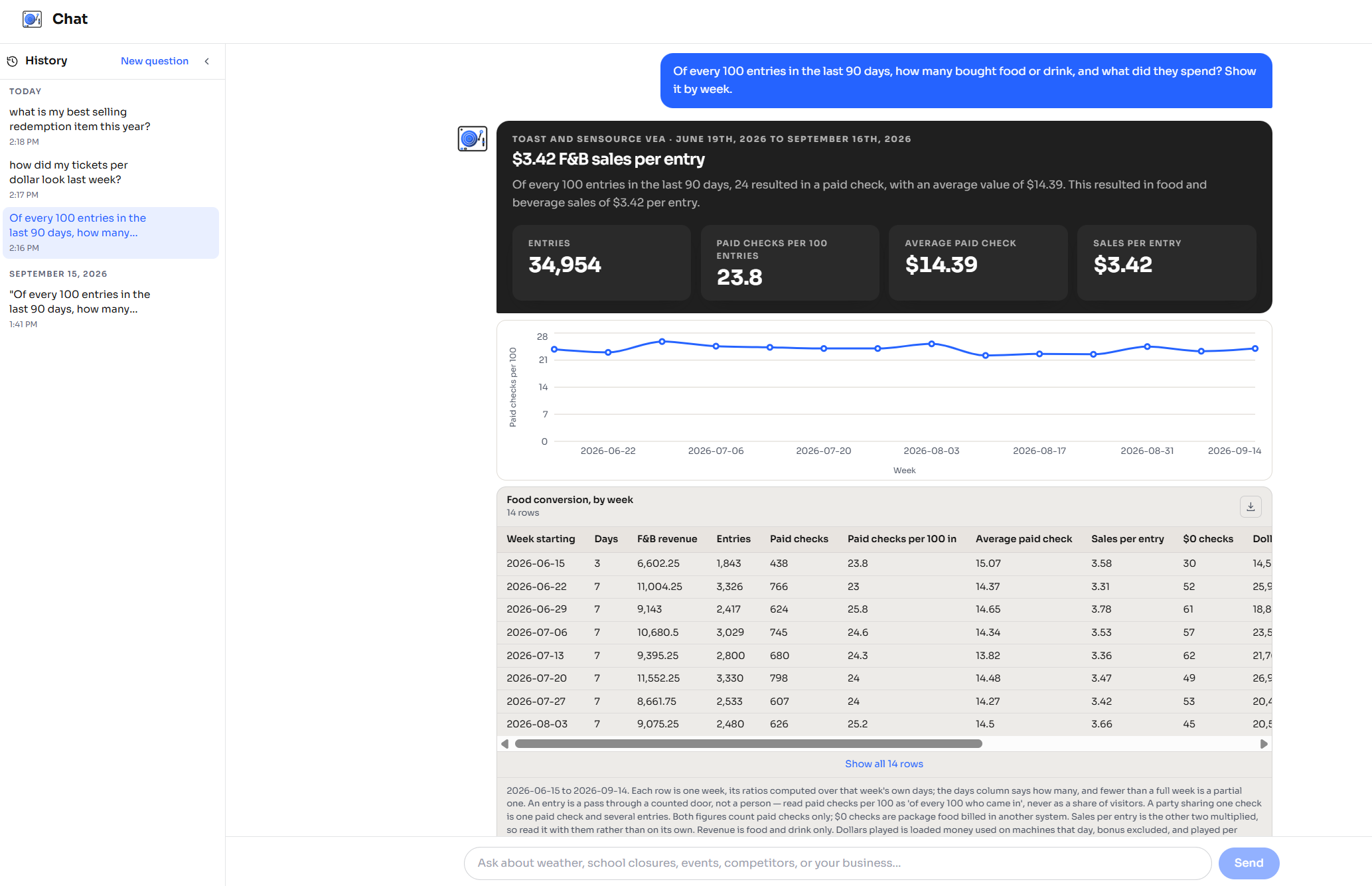
"Of every 100 entries, how many bought food?" is the cash box against the door counter. "Dollars played per entry on Saturdays" is the card system against the door. The dividing happens in code, on the same business day, every time.
-
It says what it can't say
There is no per-guest figure, because a door count is passes, not people. A card is not a person. A hot Saturday and a slow Saturday are two facts, and it will not tell you one caused the other. When a question has two readings, it asks which you meant.
-
Every answer is a cue
The source, the period, the figures as tiles, a chart, a table, and a one-line caveat. Download the table as CSV or Excel, or print the answer to PDF with its chart.
-
It remembers the conversation
"Now just Saturdays." "Drill into those days." A follow-up carries the thread, and your history keeps every answer exactly as it was shown, so "what did it tell me last Tuesday" has an answer.
Trained on your business.
Out of the box it knows what a family entertainment center is. In the first weeks it learns what yours is, and the monthly working sessions are where that happens.
- Your words. If you call a top-up a card load, so does it. If "Total Sales" at your venue is three systems added together, that's the definition it answers with, and it's written down where you can read it.
- Your systems. It knows which system does what at your venue: which one rings up bowling, which one holds the parties, where the door count comes from. So "sales" means all of yours, not the one it happened to find.
- Your figures. Every number it can report has a definition on file for your account: what it is, where it comes from, how it's worked out, and the caveat that goes with it. The dictionary in the app is that list, and you can read every entry.
- Your rhythm. Your business day, your schedule week, your holidays and the school calendars that feed you, so "last Saturday" and "Labor Day" mean what they mean to you.
The sessions are where we sit with you and do this: walk through your definitions, correct the ones that don't match how you run, and add the ones nobody has asked for yet. It gets more yours every month, without ever training on anyone's data.
Things people ask it.
- How did last Saturday compare with a normal Saturday?
- Which games look broken?
- Dollars played per entry, by week, for the last 90 days.
- Which competitors stay open later than us on Fridays?
- Labor hours by day of the week, by month.
- What did the top prizes cost us in tickets last week?
- How many households with kids live within ten miles?
Questions we get.
How does it learn my business?
From you, in the working sessions, and from your systems as they connect. We record your definitions and your vocabulary on your account, so the answers use them from then on. It doesn't guess what you meant by a word; it uses what you told us.
Can it be wrong?
The figures can't be made up, because they're computed. The words around them can misjudge a question, which is why every answer carries its chart and table built from the same rows, and names the system. If the sentence and the table disagree, trust the table, and tell us.
Does it use my data to train anything?
No. Your records are read to answer your question and go nowhere else. The model is not trained on them.
What can't it answer?
Anything your systems don't record. It will say so plainly rather than estimate: if there's no head count, there's no per-guest figure, and it will offer the nearest thing that does exist.
Who sees my questions?
You, and your account's admins. Our staff's questions on your account are marked as ours and never appear in yours.
Can I get the data out?
Yes. Any table in an answer downloads as CSV or Excel, and the answer prints to PDF with its chart. Nothing is retyped: the file is the same rows the answer was written from.
How long does an answer take?
Most in a few seconds. A question that reaches into several systems can take longer, and it tells you what it's fetching while you wait.
Your venue, your questions.
See a demo in thirty minutes, on a call or by email.
Book a call Email usNothing on the calendar that works? Email us and we'll find a time.