
Turntable Ops
How we forecast.
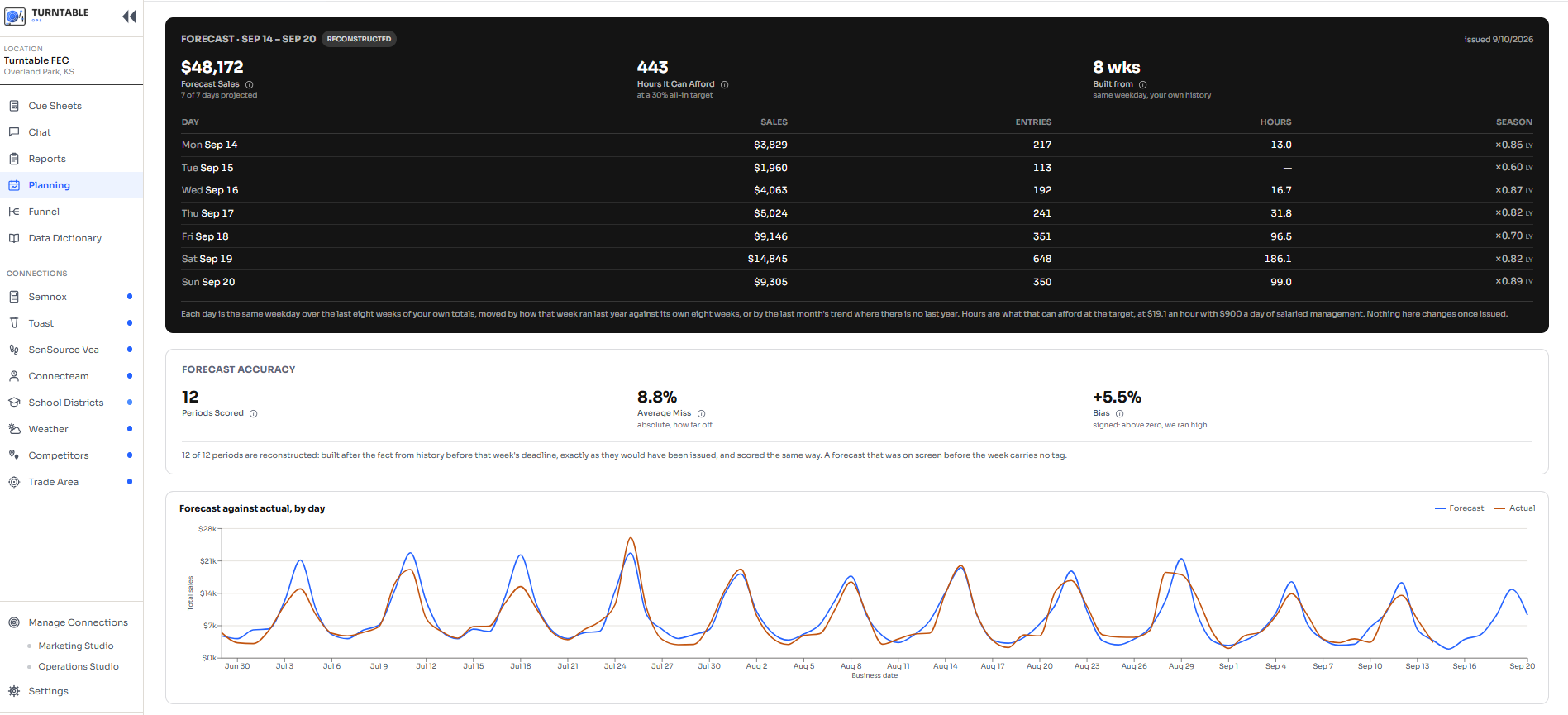
A baseline from your own history, issued before the week starts, never changed, and scored against what happened.
What a forecast is here.
A benchmark: what the week should do if you do nothing different.
-
Built from your own days
One total per business day. Every system you run is added in. Each day is projected from the same weekday over your last eight weeks. Then it is leaned by how the same three weeks ran a year ago.
-
Recorded before you act
It is issued before you build the schedule, and it carries the deadline it had to meet. It is never rebuilt. A number that moves after the fact can't tell you anything about what you did.
-
Then you measure against it
Run the promotion, move the staffing, change the hours. The week lands above the line or below it. Every day and every week is scored, with the average miss and the lean printed beside it. A change you made reads against a baseline, not against last year's memory.
Questions we get.
How accurate is it?
We tell you, on the same screen, every week: the average miss and the lean. We won't quote a number here, because the honest one is yours and it changes as your history grows.
What does it need before it starts?
Three things. Ninety days of your own totals. Every system that takes money connected, because a total missing a part is a different number. And which day you build the schedule, so the forecast has a deadline to be held to.
Why weekly?
Because that's when you build the schedule. If you build it every two weeks, the forecast covers two weeks. The cadence is yours; the deadline follows from it.
Can I change the rate or the target?
Yes, on the Planning page, any time. A forecast already issued keeps the assumptions it was issued with, so what we told you on Thursday stays what we told you on Thursday.
Does it learn?
It uses more of your history as there is more of it. It does not tune itself to look better against last week; a model that did would be scored on data it already had.
What is the "test" part?
Once there's a baseline, a promotion, a schedule change or an ad can be measured against it: what the week did against what it should have done. That's what the working sessions are for, and it's the part that turns a forecast into a decision.
Your venue, your questions.
See a demo in thirty minutes, on a call or by email.
Book a call Email usNothing on the calendar that works? Email us and we'll find a time.